There’s this old Finnish sketch of Uuno Turhapuro in which he’s gone to check on his friend – Sörsselsön – at the friend’s cottage. Uuno stands about 50 meters from the cottage. It’s midnight. Peculiarly, instead of knocking on the door, he decides to shout from afar.
- Uuno: “Were you still sleeping?”
- Sörsselsön: “What!?”
- Uuno: “I asked, were you still sleeping?”
- Sörsselsön: “Where!?”
- Uuno: “Slee-ping!”
- Sörsselsön: “I haven’t been anywhere - I was sleeping!”
- Uuno: “Where?”
- Sörsselsön: “Slee-ping!”
- Uuno: “That’s what I just asked!”
- Sörsselsön: “Asked what!?”
- Uuno: “That – were you still sleeping!”
Although the sketch is from sometime during the 1970s, it’s an apt metaphor for a typical remote conversation today via text.
I have worked in many group settings – bands, student groups, volunteer house committees, teams of developers, a small start-up, cross-functional work groups, managerial work groups and, now again, in some more groups of students. I have worked in a couple of groups in which I have not known the people beforehand and we have never met in person – and I just recently finished a project with such a group.
Despite the group’s initial meeting on each one’s expectations, commitment and motivation – and everyone was supposedly motivated – the whole group fell silent almost right out of the gate.
Then one of the guys reached out to me one day, sidelining our chosen communication method (a Whatsapp group) by private messaging: “Managing groups and people is hard, isn’t it?” I wasn’t sure how to interpret that. I think he was empathising with my challenges with the group as I had just written some conversation starters, but then was left hanging by the rest of the group. However, I had not been appointed leader of any kind and his sincerity wasn’t obvious; The chat conveyed poorly real human connection and it didn’t help me that he sprinkled the messages with emojis and animated gifs – the finger-salt of conversations for those keeping up with the times.
Later, when I posted a request-for-comments (RFC) to shape and steer our design – nothing… Crickets. Even that guy who previously reached out to me ghosted the channel for a week before eventually tagging the RFC with a thumbs-up emoji and disappearing for another week or so. It was a long-running course and the project seemed quite trivial given my work experience on the topic, so I didn’t want to waste my time or get too bothered.
The group meetings were held online and always with cameras turned off. Considering we had not met in person, this was a little new to me, and I was rather curious about how the group dynamics would evolve – or if they would at all. We could have used cameras, read each other’s faces and reactions – or lo and behold – met in person? But obviously we didn’t. Obviously that felt like waste of time and resources. Because obviously “we knew better”. So we used chat and never saw each other. And frankly, occasionally, it felt like the Uuno Turhapuro sketch.
What would be the benefits of meeting in person? Fournier puts it concisely: “The bedrock of strong teams is human connection, which leads to trust.” [1] Albeit, she mentions that in the context of 1on1s with managers and not group work in general.
I was sceptical about routine 1on1s when I first encountered them. I still am, a bit, but I used to, too. I have since found that they allow time and space to share thoughts that might not otherwise surface; they help to build rapport amid social interactions, which are nuanced, contextual, and situational. They need time and effort to unpack. Like, for example, when I reminisced to my manager about a retrospective I had arranged, and noted that “you know I’m not doing it because I want that. I do it because I think it benefits the group” and I think I saw a glint in my superior’s eyes as if he had a mild Aha-moment. Maybe it was just the reflection of the sun glimmering on my hubris. But it felt like we cleared something.
Camille Fournier also explains in her book that in person you can pick up cues from body language and other reactions to help with communicating, because language alone – text – has its issues:
(…) people are not good at saying precisely what they mean in a way that others can exactly understand. We have yet to achieve Borg hive mind or Vulcan mind meld, so we’re constantly pushing complex ideas through the eye of the needle of language. And language is not something that most engineers have mastered in nuance and interpretation. [1]
I visited Ericsson last spring and their presentation drilled home that meeting people helps. Allegedly, this wisdom is based on experience rather than precise quantifiability. For example, recognising the mental health of others is hard to do using only surveys and quantitative metrics. You have to meet them to know them.
Thomas Allen came up with the Allen curve when researching research and development workflows. Just sitting closer to those you want to or need to work with should help with co-work. The Allen curve depicts how engineers talk less to each other in correlation to the distance between them. That makes sense since proximity lowers the “cost” of interaction. For example, at work I can have an adhoc dialogue with my neighbouring colleague who can clarify things on his behalf, which we call “sparring”. It’s a quick back-and-forth covering the same ground in minutes that would take half an hour of typing on Slack.
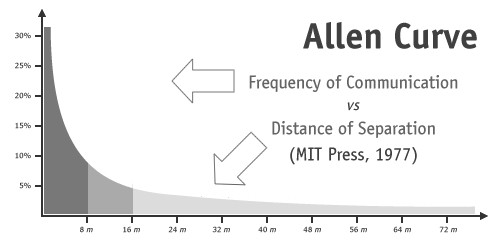
There are also specific stages at which working in person and in situ is productive. A teacher of mine, who previously worked on spearheading projects at Nokia and some other enterprises, mentioned a rule of thumb I have kept in mind since: working in person usually speeds things up, especially during the start and end of a project.
For example, I was working on accessibility for a product – specifically coordinating a contrast-mode for its UI – and, during a single stint, I could brief in the graphical designer, look over some examples with her and clear out any misunderstandings using pen and paper. The next day, she had the first layout and started on a second. As we were present at the office and had concerns about the schedule – they had not allocated time for any layouts initially – we went over the layouts with her manager to ascertain we were on the same page. I left them to it and walked back to my desk. Midway, they called me back: they preferred the first layout so much, they decided to go all-in with only that. Among other things, we chafed off days of work that would have been discarded in less time than it took me to walk from one end of the office to the other. Then, we could finetune the details in peace and were remote as we had laid the base in person.
And prototypes! Communicating in person has the advantage of using different aids with better latency. Adam Savage wrote an excellent book Every tool’s a hammer, in which he tells a few compelling cases on putting physical things – cardboard mock-ups among other conversation pieces such as drawings – in between people to bridge the gap of communication [2].
We are indoctrinated to build defences and be reserved to varying degrees; we try to get a feel for the environment to figure out what is expected of us; we read the room; we observe ways that carry the message best. Those hesitations accumulate into delays and blockers. Trust is a catalyst for the flow, and the convenience of working together in person/in situ can be the oil that lubes that flow even more.
I worked with a test engineer who worked mostly evenings. It worked well – we knew each other from years before having been in the same band playing venues around Finland. I knew I could trust him to tweak and punish the product with more ideas I would have, and come the next day, he’d have a specific follow-through of the problem – maybe having already bisected the exact commit at which point the issue started – maybe even having dug in to figure out what in the code might be the culprit even he wasn’t that much of a coder. And I knew he would tell me if this arrangement wasn’t working. It saved a lot of energy and time knowing we’d surface problems promptly and appropriately when there was a need for it, but otherwise we could dig into our work.
I’m not saying in-person or in-situ co-work is always better. I prefer to work remotely for certain things. For example, if I have plan out, design or code something extensive, it’s nicer to have my privacy, peace and quiet. Choosing to work in person or in situ is about seeing patterns and recognising “why and when” to reduce cognitive overhead.
To conclude, I agree with Jen, whom Adam Savage quotes in his book [2]:
There’s a level of transcendence that you can get to when you’re working by youself on a project and everything’s sort of vibrating and you’re just in the zone. But, it’s a whole other level when you’re doing that with other people.
- C. Fournier, The manager’s path: a guide for tech leaders navigating growth and change. Beijing: O'Reilly, 2017.
- Savage, Adam, Every Tool’s a Hammer: Life Is What You Make It. Atria Books, 2020.